
Reconstructive and Distinguished Shoulder Surgeon
-
Comprising of three bones:
It is made of the clavicle (collarbone), the scapula (shoulder blade), and the humerus (upper arm bone). Since the ball of the upper arm is larger than the socket that holds it, shoulder joint is the most movable but unstable joint in the body and to enable it to function properly it is encompassed by muscles, ligaments and tendons.
-
Instability or propinquity of the tissues:
is affected by the excess mobility of the shoulder joint. This feature also makes it susceptible to many common injuries and disorders which result in pain, numbness and loss of movement in the arm and shoulder area. The common problems enacted upon by the shoulder surgeon are fractures, dislocations, arthritis, frozen shoulder, rotator cuff tears, labrum tears or shoulder impingement.
-
By over the edge and new modality techniques:
Shoulder surgeon undertakes to repair, restore, rejuvenate the affected shoulder joint and skillfully provides relief to the patient. By a combination of conservative, therapy sessions and minimal as well as complex surgical techniques the debilitation in the shoulder is sought to be removed as effectively and painlessly as possible.
A tour of hand2shoulder clinic:
A relatively new branch of medicine, which deals in the treatment of congenital disorders, injuries sustained by the upper limbs of our body comprising of shoulder, elbow, hand and wrist joints. It is the upper limb functionality that makes humans unique from other species.
Hand2shoulder clinic specializes in consultation and all surgical, non-surgical techniques of treatment to each and every complex condition traumatizing the patient and hindering his daily activities.
Compilation of all relative detailed information about every condition and treatment has been put forth on our website to facilitate knowledge to both patients and medical professionals who would want to delve into it further.
An insight into Dr. Vikas’s professional profile:
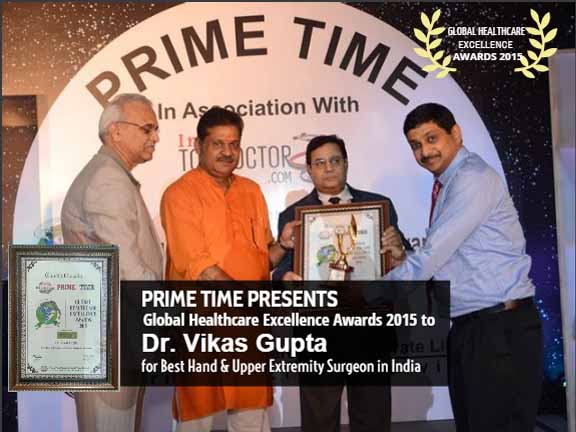
Founder of the Hand2shoulder clinic Dr. Vikas Gupta is an MBBS from All India Institute of Medical Sciences, New Delhi and an MS in Orthopedics from All India Institute of Medical Sciences, New Delhi too. Having completed intensive surgical training from USA and Germany, he is in the field of upper extremity for the past 25 years. He is credited as the first surgeon to introduce many new and international techniques to India in his field. More than 6000 surgeries have made him distinctive and he is considered to be one of the most skilled and stable hands to perform any complex surgery.
Why choose us?
Hand2Shoulder Clinic on National Geographic
Case operated by Dr. Vikas Gupta covered by National Geographic Team for serial "Emergency Room". This video highlights careless attitude can lead to grievous injuries which can lead to permanent disability and these if treated properly on time can bring back person towards normal life.....
What they say about us!
@ “Fortunate to find Dr. Vikas Gupta at the right time. A very qualified and learned doctor and I felt in safe hands after I met him. Scaphoid of my wrist was broken and there are only few doctors who could cure it. After the operation and physiotherapy, I am almost back to full flow.”
 Sachin Gupta
I came to Dr Vikas Gupta with a loss of sensation and numbness in my right hand ( in month of April 2006). He advised me to undergo an endoscopic operation of the carpal tunnel syndrome. I underwent surgery at AIIMS on 2nd may 2006 by Dr Vikas Gupta. I was feeling perfectly alright within a few days of the surgery. In around 4 weeks time I was able to perform my normal activities (in merchant Navy). I am really thankful to him
 Harpreet Singh
I am practicising as a neurosurgeon in south Delhi for last 18 years. I sustained a fracture scaphoid right wrist. I got scared as far as my knowledge of scaphoid fracture was that it is notorious for nonunion (not uniting) and avascular necrosis (bone becoming dead). These thought are like nightmare for neurosurgeon. It was then a came to know about Dr Vikas Gupta who was fixing these fractures percutaneously (without opening fracture) with screws. When I approached him he was confident that he would be able to fix my scaphoid with this minimally invasive technique and scheduled the surgery next day. Later I came to know that he was first person to fix scaphoid percutaneously in India. . I was able to start operating within 3 weeks of surgery. Presently I don’t have any complaints in my right wrist
 Dr. V.K. Rajoria
Treatment Techniques:
Depending on the area in the shoulder joint that is damaged or injured, the severity of the pain and the patient’s personal condition related to other diseases, the shoulder surgeon chalks out an appropriate treatment plan to heal the patient.
Non-Surgical Techniques:
The shoulder surgeon initially begins the treatment with conservative techniques like prescribing anti inflammatory medicines and steroid injections thereafter fused in with physical therapy exercises to enable the patient to restore movements. If these non surgical techniques then the surgeon moves on to the best technique applicable as per the debilitating condition of the affected area in the shoulder.
Platelet Rich Plasma Therapy:
Non surgical and relatively new this technique is completed in only 20 minutes. After careful examination, the surgeon determines whether the patient is suitable for this treatment or not. If yes, then the surgeon inserts an injection in the affected joint, rich with platelet rich plasma that starts healing after a few weeks.
Shoulder Arthroscopy:
With 2 minimal cuts (1/4th inch) an Arthroscope (a very small fibre optic instrument made of lens and video camera) and tools ( 3 to 4 mm in diameter ) are inserted into the affected joint area and treated by the shoulder surgeon effectively. Arthroscopy is taken up when conservative treatment techniques and therapy have proved inefficient to heal the damage. It results in faster healing and less traumatic than an open surgery.
Total Shoulder Replacement:
Patients suffering from arthritis, degenerative joint disease, rotator cuff tears or severe fractures sometimes lose their ability to move the shoulder joint and suffer from extremely unnerving pain. To enable them to restore lost movements and relieve them of pain the shoulder replacement technique or Arthroplasty is adopted by the surgeon whereby the damaged ball and socket joint is replaced and an artificial joint is cemented in.
Reverse Shoulder Replacement:
In cases of severe rotator cuff tears, arthritis or failure of previous shoulder replacement, reverse shoulder replacement surgery is undertaken by the surgeon where natural joint is replaced by prosthetic joint to relieve the patient of the enervating condition. In reverse shoulder replacement surgery, the socket is attached to upper arm bone and metal ball attached to shoulder bone thus allowing the patient to work with deltoid muscle instead of torn rotator cuff.
Stemmed Hemiarthroplasty Technique:
Under this technique the surgeon only replaces the damaged ball of the socket with a metal ball and stem. This is undertaken by the surgeon only when the humeral head is damaged but the socket is in normal condition.
Resurfacing Hemiathroplasty:
An alternative technique to the stemmed hemiathroplasty, only the joint surface of the humeral head is replaced by a cap like prosthesis without a stem, under this technique. It is relatively easy and mostly applied to young and highly active patients.
Open Surgical Technique:
To obtain better results than arthroscopy and to treat severe cases that cannot be treated by arthroscopy, open surgery is performed with incisions that are a few inches long. It takes a while longer to heal from open surgical technique as the cuts are deeper than arthroscopy and surgeons only adopt open surgical technique when no other treatment has proved to be effective.
Rotator Cuff Tear:
This is a commonest problem among > 40 years of age. It mainly due degenerative change of tendinous fibres of the rotator cuff muscle at their insertion into the tuberosity with advancing age. It composed of 4 muscle and tendon that surround humerus. Their function is to help in rotating the arm and stabilize the joint.
Shoulder Impingement/Rotator Cuff Tendonitis:
Impingement can be caused when acromion impinge on the rotator cuff and bursa which cause irritation or damage. It is common in young athletes and middle aged people. Young athletes use their arm overhead for swimming, baseball and tennis
Our Location & Address
M-3, Gurdwara Road, Greater Kailash-2, New Delhi-110048 | E-mail: info@hand2shoulderclinic.in | Tel.: 09899104263, 09311224263

